
The YesWeYaa journal
Why So Many Kashmiri Students Quit School After Class 8
Primary schools are full, but too many students vanish after Class 8, exposing the system’s hidden failure.
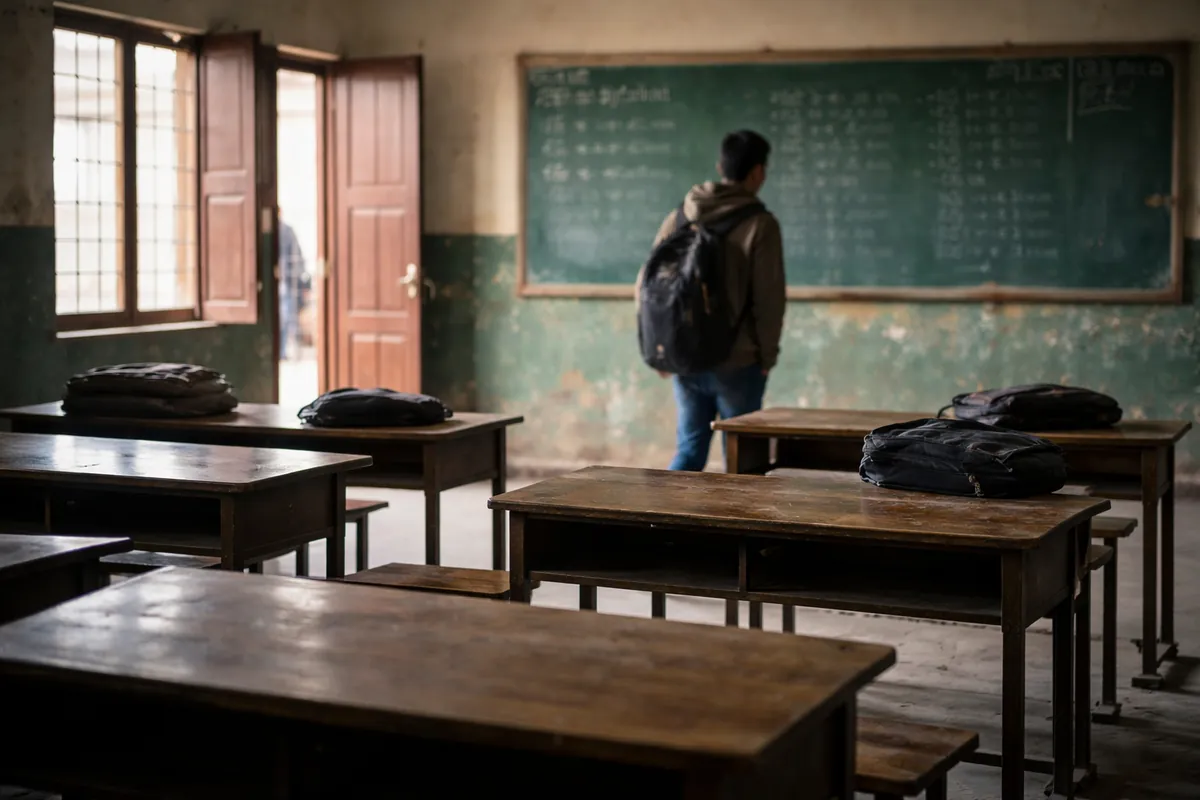
Schools in Kashmir have mastered the art of arrival, though they have yet to learn the craft of staying.
One can find primary classrooms humming with life in the valley, children sitting in neat rows while attendance registers swell with names.
Over the past decade, enrollment drives reached into remote hamlets where government schemes delivered meals, uniforms, and small cash incentives that convinced families to act.
They sent their daughters and sons to school in numbers matching national averages, bringing primary dropout rates down near 1.5 percent, statistics that suggest a story of genuine progress.
But the statistics mislead anyone who looks closer.
Follow those same children past Class 8 and the narrative collapses into something far less encouraging.
Secondary school dropout climbs to 12 or 13 percent, and after Class 10 nearly 28 percent of students vanish from the education system entirely, leaving behind empty desks and truncated futures.
They do not fail in any formal sense, nor do they transfer to other institutions, they simply leave without ceremony or record.
The door that swung open so welcomingly at age six narrows to a crack by age fourteen, revealing an education system that triumphs at the starting line only to surrender the race when it matters most.
Policy in Kashmir, like much of India, spent years fixated almost exclusively on access, pouring resources into programs that brought bodies into buildings.
Mid-day meals fed hungry children while Samagra Shiksha funds constructed rooms and hired teachers across the valley, generating the political theater of progress through ribbon cuttings, enrollment charts, and speeches heralding universal education.
What these efforts failed to construct was any meaningful bridge between showing up and actually seeing it through to completion.
Class 9 marks the breaking point where academic demands multiply overnight and many students falter.
Board exams loom on the horizon, specialized subjects pile onto schedules, and teachers assume foundational competence that many children simply lack.
Large numbers advanced through earlier grades without ever mastering basic reading or mathematics, occupying desks and moving up each year while learning far less than appearances suggested.
By secondary school, those gaps become impossible to conceal, causing confidence to evaporate and attendance to fray until the student disappears entirely.
Economic pressure seals the exit for families operating on thin, uncertain margins where costs spike sharply after Class 8.
Transport fees, private tuition, exam registration, and textbooks that grow heavier and costlier each year pile onto household budgets already stretched tight.
At this same moment, older children become more valuable as earners, with boys drifting into informal work or family shops while girls absorb domestic responsibilities and face tighter limits on mobility outside the home.
School competes against immediate survival in these calculations, and school too often loses.
Distance magnifies hardship, blending itself into the routine of rural life.
Primary schools dot the landscape so densely that a child in a remote village walks only ten minutes to class, while secondary schools cluster in towns requiring hours of travel each day.
This journey demands money, physical endurance, and reliable transport that winter weather frequently disrupts, with snow blocking mountain roads and cold seeping into unheated buses.
Families watch their children struggle through these harsh conditions and make the rational choice to keep them home, transforming the safer option into the permanent option.
School rationalisation policies deepened these wounds in recent years as officials merged thousands of government schools under the banner of efficiency. They promised better resource use and improved teacher deployment, delivering on those promises in some locations where schools gained students and facilities. Other schools vanished from communities entirely, leaving rural students to travel farther for fewer options while access became a statistic on a spreadsheet rather than any lived reality.
Private schools widened the divide by giving an escape hatch for families with means, who pulled their children from government institutions while chasing perceived quality.
This exodus left public schools with shrinking enrollment, demoralized teachers, and classrooms where the poorest students cluster together without the peer dynamics that help drive achievement.
The gap between those who can pay and those who cannot grows wider each year, sorting children by income as much as by ability.
Gender tells its own story of partial victory and eventual retreat.
Girls enroll at rates matching boys through the early years, with campaigns convincing families to invest in daughters alongside sons. That commitment frays in higher classes where social pressure around mobility, and expectations about marriage pull girls out despite their early promise.
The valley achieved parity at the schoolhouse door without ever securing it inside.
The pandemic left wounds that refuse to close completely, as students returned after prolonged closures with uneven preparation that carried forward into every subject.
Many advanced through grades without basic competency in reading or mathematics, leaving them drowning in secondary school material they never mastered during those lost months. Disengagement followed naturally, as did eventual departure from the system entirely.
Kashmir’s education system succeeds at the easiest task of bringing children into buildings, then loses them precisely when education begins to shape real futures. Early enrollment creates a political narrative of progress that late-stage dropout reveals as incomplete, showing a system that opens doors without developing the strength to hold them open.
Repairing this demands more than continued obsession with primary schooling metrics that look good on paper. Secondary education needs equal investment in more rural schools, reliable transport, and financial support extending through adolescence when family budgets face their greatest strain.
Classrooms need stronger attention to foundational skills so students reach higher grades prepared to learn rather than struggling to catch up.
Kashmir stands at a decisive moment in its education journey, having built a foundation that reaches nearly every child while failing to construct the full structure upon that base.
The next phase demands equal commitment to continuity, ensuring students who enter school leave with skills, credentials, and options rather than empty hands and narrowed futures.
A system that opens the schoolhouse door earns full credit only when it keeps students walking through until the finish line.
Kashmir has mastered the first step with admirable success. The future of an entire generation depends entirely on mastering the rest.
— The author is a senior educator in Kashmir.